

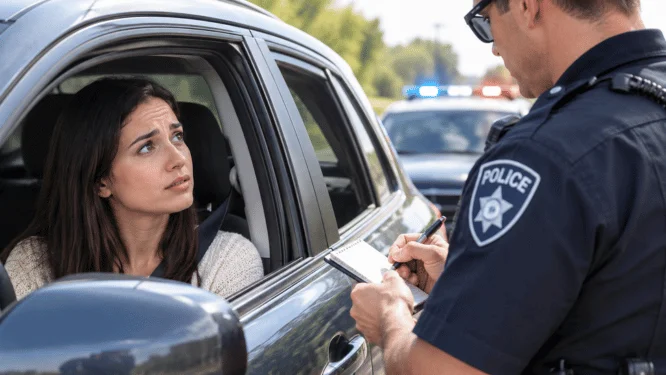
If you’re wondering what happens if you get pulled over without your license on you, the answer depends on one key fact: whether you’re legally licensed to drive.
Short answer: If you have a valid U.S. driver’s license but left the physical card at home, police can usually verify your identity and license status. You may still receive a citation. The situation becomes much more serious if your license is expired, suspended, or revoked, or you never had one. Exact penalties depend on state law.
| Situation | What May Happen | Typical Seriousness |
|---|---|---|
| Valid license, card left at home | Verification, warning, or citation | Usually minor |
| Official digital license accepted by the state | May satisfy the display requirement | Depends on state |
| Expired license | Citation or more serious charge | Moderate |
| Never licensed | Fine, possible criminal charge, vehicle complications | Serious |
| Suspended or revoked license | Criminal penalties may apply | Potentially very serious |
The biggest mistake is treating all of these situations as the same offense. They aren’t.
What Happens If You Get Pulled Over Without Your License on You?
During a normal traffic stop, an officer commonly asks for your driver’s license, vehicle registration, and proof of insurance. If you don’t have the card, explain that you hold a valid license but don’t have it with you.
The officer may ask for identifying information such as your full name, birth date, and address. Law enforcement databases can often be used to confirm whether you have valid driving privileges. This electronic check is normally the next step in a stop of this kind.
Verification does not automatically erase a violation. Many states require licensed drivers to carry or display their credentials while driving.
For example, Texas Transportation Code Section 521.025 requires a driver to possess the appropriate license and display it when a peace officer demands it. A violation can carry a fine of up to $200. Texas law also provides a defense when the driver later produces a license that was valid at the time of the offense.
Forgetting a Valid License Is Different From Driving Unlicensed
This distinction matters more than almost anything else.
Suppose you passed the required tests, received a valid license, and left your wallet on the kitchen counter. You still have legal driving privileges. Your problem is that you can’t immediately produce the credential.
Someone who never received a license is in a different legal position. The same is true for a driver whose privilege has been suspended or revoked.
California illustrates the difference well. Vehicle Code Section 12951 requires a licensee to keep a valid credential in their immediate possession while driving. A charge for failing to possess it is generally dismissed when the person produces a license that was valid at the time, subject to the statute’s rules for repeated charges.
That is very different from being caught behind the wheel when you have no legal authority to drive.
Can You Get a Ticket Even If Your License Is Valid?
Yes.
Having valid driving privileges does not necessarily mean you complied with your state’s requirement to carry or present proof of them.
An officer may give you a warning, but a citation is also possible. What happens afterward depends on the jurisdiction. Some states or courts allow a driver to prove that the credential was valid on the date of the stop and have the charge dismissed or resolved more easily.
Texas is a clear example. State law requires possession of the credential but gives a driver a defense when the required valid license is produced in court.
This is why you should read the instructions on any ticket rather than assuming it disappears once you find your card.
For more plain-English explanations of legal terminology, Artandwriters also has a guide to soliciting and its meaning in legal contexts.
What If Your License Is Suspended, Revoked, or Expired?

This is where the consequences can escalate.
A forgotten card means you may still have valid driving privileges. A suspension or revocation means the state has restricted or removed those privileges.
Driving anyway can expose you to more serious penalties. Depending on the state and your history, those consequences may include fines, additional suspension time, misdemeanor charges, vehicle impoundment, or possible jail time.
An expired credential can also create a different problem from leaving a current one at home. State laws determine whether the offense is handled as a minor licensing violation or something more serious.
Florida, for example, separately prohibits driving on its highways unless the person has a valid driver’s license, subject to statutory exceptions. The statute provides escalating misdemeanor penalties for violations of that licensing requirement.
If a database check shows your privileges are suspended or revoked, don’t assume the stop will be treated like a forgotten-wallet situation.
Can You Show a Picture of Your License on Your Phone?
A photograph of a plastic card should not be treated as a universal substitute for the credential itself.
Official mobile driver’s licenses are different. They are state-issued digital credentials with security and verification systems.
Rules remain inconsistent across the country. The American Association of Motor Vehicle Administrators tracks jurisdictions at different stages of mobile driver-license implementation, showing that adoption is not uniform nationwide.
Florida provides a useful example of how specific these rules can be. State law permits a licensee to present approved digital proof instead of a printed credential. If an officer cannot immediately verify the digital proof, the driver can still be required to produce the printed license.
So, before depending on your phone, check your own state DMV or motor-vehicle agency’s current rules.
Could Your Car Be Towed?
It is possible, but leaving a valid card at home does not automatically mean your vehicle will be impounded.
The risk becomes higher when the officer determines that you cannot legally continue driving. That can happen when your privileges are suspended, revoked, or nonexistent.
The outcome may also depend on whether another properly licensed person is available to drive the vehicle and on local towing rules.
If you’re interested in other practical automobile topics, Artandwriters also covers issues such as Statutory.
What Should You Do During the Traffic Stop?
The safest approach is straightforward:
- Pull over safely and keep your hands visible.
- Tell the officer truthfully that you don’t have the physical card with you.
- Give accurate identifying information when requested.
- Don’t claim that a photograph or unofficial app is legally equivalent to a license.
- Read any citation carefully and note its deadline.
- Confirm your current license status with your state motor-vehicle agency after the stop.
- If your privileges are suspended or revoked, do not keep driving unless you have legal authorization to do so.
If you receive a ticket, respond by the stated deadline. Ignoring a citation can create additional problems even when the original issue was minor. New York’s DMV, for example, warns motorists not to delay responding to traffic tickets and explains that failure to respond can result in further licensing consequences.
Do You Have to Carry a Physical License in Every State?
Drivers should not assume that one rule applies everywhere.
States generally require drivers to be properly licensed, and many statutes also require the credential to be carried or produced on demand. Yet digital-license rules, dismissal procedures, classifications, fines, and enforcement practices differ.
Texas explicitly requires possession and display. California requires immediate possession and provides a dismissal mechanism in qualifying cases. Florida requires immediate possession but also recognizes authorized digital proof under specified conditions.
Those differences are why a nationwide article can explain the general process but cannot promise a particular fine or outcome in all 50 states.
Frequently Asked Questions
What happens if you get pulled over without your license on you but it is valid?
The officer may verify your identity and driving status electronically. Depending on state law and officer discretion, you could receive a warning or citation. Some jurisdictions provide a way to show later that the credential was valid at the time of the stop.
Can police tell if you have a valid license without the card?
In many traffic stops, officers can check identifying information against government records to determine your license status. Legal resources describing current traffic-stop procedures report this as a common practice.
Will forgetting your license add points to your driving record?
That depends on the state and how the violation is classified. A failure-to-carry offense should not be confused with a moving violation or with driving while suspended. Check the citation and your state DMV’s rules.
Is an official digital driver’s license enough?
Only where applicable law and the receiving authority recognize it. Mobile license implementation still varies across U.S. jurisdictions.
Is driving with a suspended license the same as forgetting the card?
No. A forgotten card can involve someone who still has valid privileges. Driving while suspended or revoked means the underlying legal authority to drive has been restricted or removed, which can carry much harsher consequences.
The Bottom Line
Getting stopped without the card in your wallet is usually far less serious than driving without valid privileges.
If your credential is current, stay cooperative, let the officer verify your status, and follow any instructions on the citation. If the record shows an expiration, suspension, revocation, or no valid license, the legal consequences may be much greater.
Because traffic and licensing laws are state-specific, check the official DMV, legislature, or court information for the state where the stop occurred. This article provides general U.S. information and is not legal advice.
For more practical educational content, you can browse the Artandwriters guides and explainers.