


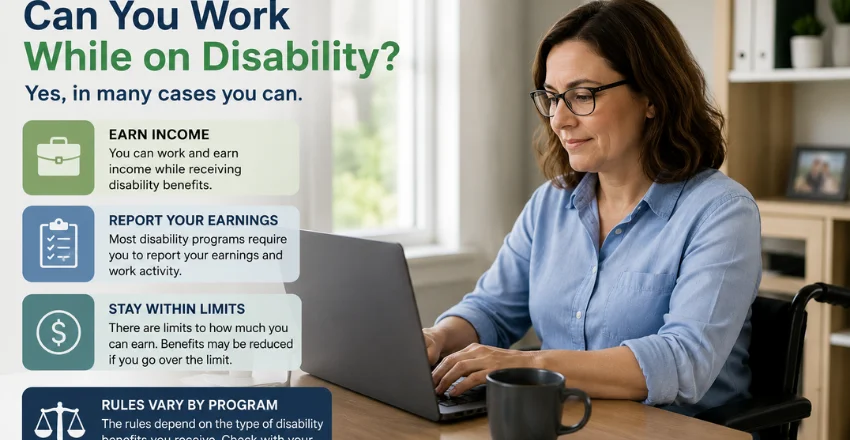
Short answer: Yes, you can work while on disability in the United States, but the effect on your benefits depends on whether you receive SSDI or SSI. SSDI provides specific work incentives before payments can stop. SSI reduces payments as countable income rises, while special rules may protect Medicaid coverage.
Getting a paycheck does not automatically cancel Social Security disability benefits. The key is knowing which benefit you receive, how much you earn, and which work rules apply to your situation.
| 2026 rule | Amount or period | What it means |
|---|---|---|
| SSDI Trial Work Period threshold | More than $1,210 per month | A month above this amount generally counts as a trial-work month |
| SSDI Trial Work Period | 9 months | You can test your ability to work while continuing SSDI payments |
| SGA for most SSDI beneficiaries | $1,690 per month | Used after the trial period and in disability eligibility decisions |
| SGA for statutorily blind beneficiaries | $2,830 per month | Higher SGA amount applies under Social Security rules |
| Federal SSI payment standard | $994 for an individual | Maximum federal monthly amount before countable income and other adjustments |
| SSI resource limit | $2,000 individual; $3,000 couple | Resource rules still apply even when work incentives are used |
These are federal 2026 figures. Some SSI recipients also receive state supplements, so their payment amounts can differ.
TL;DR
- SSDI and SSI have different rules for people who return to work.
- SSDI offers a nine-month Trial Work Period before the normal SGA test becomes central.
- A 2026 trial-work month generally counts when gross earnings exceed $1,210.
- After the trial period, the 2026 SGA amount is $1,690 per month for most people and $2,830 per month for those who meet Social Security’s blindness rules.
- SSI does not use the SSDI Trial Work Period. Instead, SSA excludes part of your earned income before reducing your monthly payment.
- Medicare or Medicaid may continue even after cash disability payments stop because of work.
- You should report new jobs, wage changes, and self-employment to the Social Security Administration.
Can You Work While on Disability and Keep Benefits?
Yes. Receiving disability benefits does not always mean you must remain completely unemployed. The answer depends first on whether you receive Social Security Disability Insurance (SSDI) or Supplemental Security Income (SSI). SSDI is based largely on your work record. SSI is a needs-based program with income and resource rules.
SSDI recipients can use several work incentives. SSI recipients can often earn wages while receiving a reduced payment because SSA excludes part of their earnings. That distinction matters more than the number of hours printed on your work schedule. Before accepting more work, confirm which program pays your benefit.
Readers looking at the household-budget side of returning to work can also browse ArtAndWriters’ finance section.
How SSDI Treats Earnings in 2026
SSDI has a structured process that lets beneficiaries test whether returning to work is sustainable.
The nine-month Trial Work Period
The Trial Work Period gives you nine service months to test working while still receiving your full SSDI payment, assuming you continue to meet the disability requirements. The months do not need to be consecutive. SSA looks for nine trial-work months within a rolling 60-month period. In 2026, a month generally counts when gross earnings exceed $1,210.
There is no SGA earnings cap on the amount you can earn during a qualifying Trial Work Period month. Your earnings can still make that month count toward the nine-month period.
What happens after the Trial Work Period?
After the trial period, SSDI beneficiaries generally enter a 36-month Extended Period of Eligibility. During this period, SSA compares your work activity to the substantial gainful activity (SGA) level. For 2026, SGA is $1,690 per month for most beneficiaries and $2,830 for statutorily blind beneficiaries, as published in the Social Security Administration’s substantial gainful activity tables.
If your countable earnings remain below the applicable level during an eligible month, SSDI payments may continue. Earnings above the limit can stop the cash payment for that month. The rules can become more complicated when SSA deducts qualifying work expenses or applies other work incentives. Do not treat gross wages alone as the final answer in every case.
How SSI Changes When You Earn Wages
SSI works differently. There is no nine-month SSDI-style Trial Work Period. Instead, SSA calculates how much of your income counts against your SSI payment. Under the standard earned-income exclusions, SSA generally ignores the first $20 of income when the general exclusion remains available. It then excludes the first $65 of earned income and half of the remaining earnings.
Consider a simplified example. Suppose you receive no other income and earn $1,065 from a job during a month. After the $20 general exclusion and $65 earned-income exclusion, $980 remains. SSA counts half, or $490, under this simplified calculation. Subtracting $490 from the 2026 federal SSI standard of $994 would leave $504 in federal SSI before other adjustments.
Your actual payment may differ due to living arrangements, state supplements, other income, deemed income, or allowable work expenses. SSI also offers work incentives that allow certain recipients to keep cash benefits even while working at SGA levels. Section 1619(a) is one such protection for eligible recipients who remain disabled and meet the other program rules.
Is There a Limit on How Many Hours You Can Work?
There is no single federal weekly-hour limit that applies to every employee receiving Social Security disability benefits. For employees, SSA pays close attention to earnings and the nature of the work. The number of hours may still help SSA understand your work activity, but a universal rule such as “20 hours per week” does not govern every case.
Self-employment receives extra scrutiny. During the SSDI Trial Work Period, a month can count as a service month if you work more than 80 hours in self-employment, even when income is low. That is one reason freelancers, contractors, writers, artists, and small-business owners should not judge eligibility from income alone.
Self-Employment Can Be More Complicated
A regular employee has pay stubs showing wages and hours. A self-employed person may have business revenue, expenses, unpaid work, irregular projects, and months with little profit. SSA can consider more than your reported profit when deciding whether self-employment represents substantial work. The agency has specific tests for evaluating services and work activity.
Keep records of your hours, invoices, business expenses, payments, and the work you perform. This is especially useful when income fluctuates from month to month. Certain disability-related expenses needed for work may also reduce the earnings SSA counts. These are called impairment-related work expenses, or IRWEs, when they meet SSA requirements.
Report Work and Earnings to Avoid Overpayments
Starting work does not mean you should wait for SSA to discover the income through tax records. Report when you start or stop a job, change your hours, experience a major pay change, or begin self-employment. Keeping copies of pay stubs and reporting confirmations can help if SSA later questions an amount.
Many SSDI and SSI beneficiaries can report wages through a my Social Security account. SSI recipients who report monthly wages are generally asked to report the previous month’s wages by the sixth day of the following month. Prompt reporting lowers the risk of an overpayment. An overpayment can create a debt that SSA later seeks to recover.
For broader explanations of U.S. rules and legal terminology, ArtAndWriters also maintains a law section.
Medicare and Medicaid May Continue After Cash Benefits Change
Returning to work does not always mean losing health coverage. Most qualifying SSDI beneficiaries can continue Medicare for at least 93 consecutive months after the Trial Work Period while they meet the applicable requirements. That provides years of potential health coverage while someone builds a more stable work history.
SSI recipients may qualify for continued Medicaid under Section 1619(b) after earnings become high enough to stop the SSI cash payment. Eligibility depends on several conditions, including resources and state-specific earnings thresholds. Because Medicaid thresholds vary by state, check the rule for the state where you live rather than using a national dollar figure.
ArtAndWriters’ health section provides additional health-related reading.
What If Your SSDI Benefits End Because You Work?
Returning to work successfully can eventually end SSDI cash benefits. That does not always mean starting from zero if your disability later prevents you from continuing. SSA’s Expedited Reinstatement rules may allow a former beneficiary to request benefits again within five years after benefits ended because of work. You may not need to file a completely new disability application.
SSA can also pay up to six months of provisional benefits while it decides an eligible reinstatement request. This protection can make a work attempt less financially risky for someone whose condition may fluctuate.
Working While Applying for Disability Is Different
The rules above mostly describe people who already receive benefits. Applying for disability while working is a different situation. For an initial disability claim, SSA generally considers whether your work is substantial gainful activity. In 2026, the SGA amounts are $1,690 per month for most applicants and $2,830 per month for statutorily blind applicants.
Earning more than the applicable amount can make an applicant ineligible at an early stage of the disability evaluation, subject to SSA’s rules for countable earnings and special circumstances. Do not assume that the Trial Work Period allows a new applicant to earn any amount for 9 months. That work incentive applies to eligible SSDI beneficiaries after entitlement.
Other Disability Programs Have Different Work Rules
“Disability” can refer to more than Social Security. Private long-term disability insurance, employer plans, workers’ compensation, state disability programs, veterans’ benefits, and other public programs have separate definitions and income rules. An insurer may use an “own occupation” or “any occupation” disability definition. Workers’ compensation rules differ by state.
Veterans’ disability compensation follows the Department of Veterans Affairs’ rules rather than the SSA’s earnings system. This article covers federal Social Security SSDI and SSI rules. Check the governing program before relying on its dollar limits.
Check Your Benefit Type Before You Increase Your Earnings
Start with one question: Do you receive SSDI, SSI, or both? Then review your recent earnings, determine whether you have already used any Trial Work Period months, and keep records of every wage report. If you are self-employed or close to an earnings threshold, ask SSA or a qualified benefits counselor how the rules apply before making a major change.
Working can be compatible with Social Security disability benefits. Knowing the correct program rules before your income changes is the safer way to avoid unexpected payment interruptions or overpayments.
Frequently Asked Questions
Yes, in many cases. SSDI recipients can use work incentives such as the Trial Work Period and Extended Period of Eligibility. SSI recipients may continue receiving reduced payments while earning wages. The outcome depends on your program, earnings, work activity, and other eligibility rules.
There is no ordinary SGA cap during the nine-month Trial Work Period, although a month generally counts when earnings exceed $1,210. Afterward, the 2026 SGA level is $1,690 per month for most beneficiaries and $2,830 for statutorily blind beneficiaries.
No. A part-time schedule does not automatically end SSDI. SSA considers earnings, work activity, the stage of your work-incentive period, and other applicable rules.
Often, yes. SSI usually decreases gradually because SSA excludes a portion of earned income when calculating the payment. Some recipients can also use Section 1619 work incentives.
Yes. Self-employment and other work activity should be reported to SSA. Keep records of income, expenses, hours, and changes in the business because self-employment is evaluated differently from ordinary wages.