
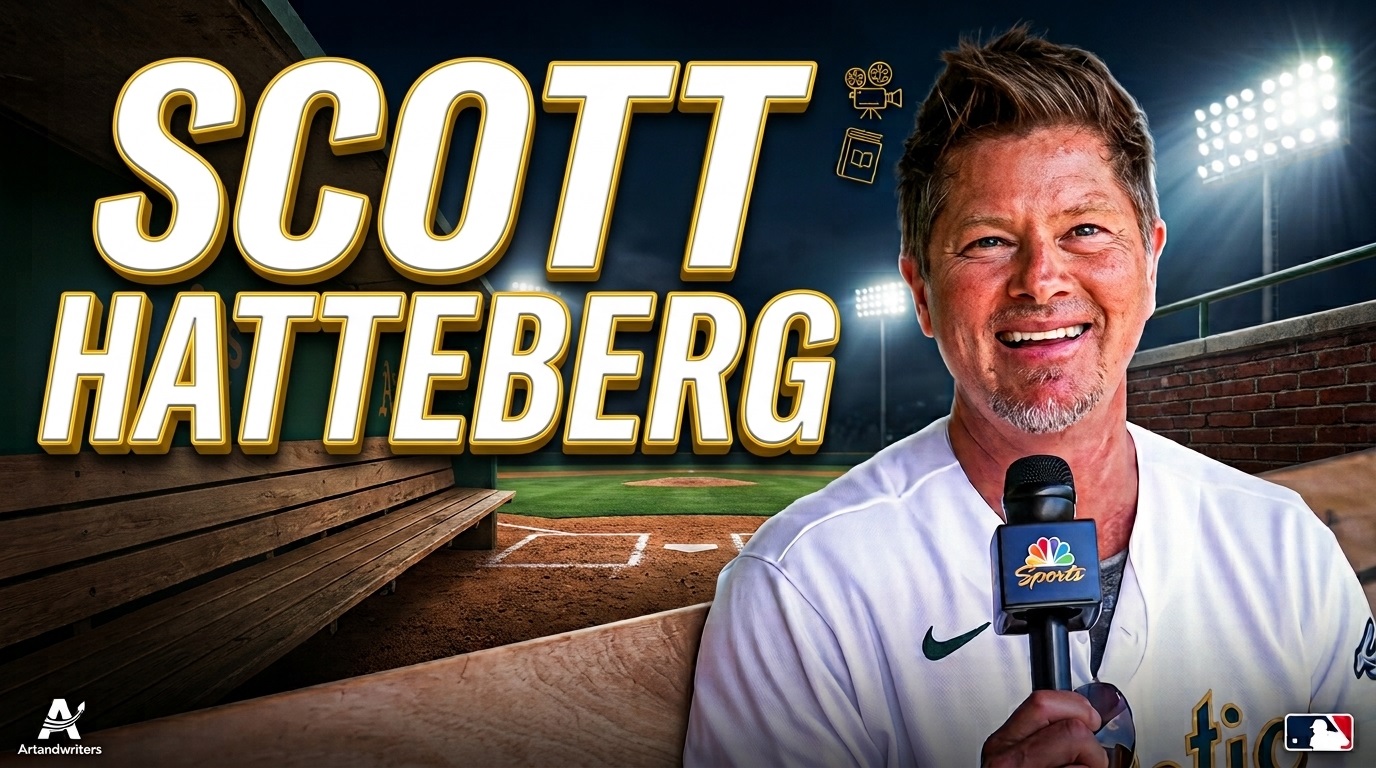
Scott Hatteberg became one of baseball’s most recognizable comeback stories through the 2002 Oakland Athletics. A serious arm problem threatened his career as a catcher. Oakland instead saw value in his ability to reach base and taught him first base.
The Scott Hatteberg story later became an important part of Moneyball. Chris Pratt portrayed him in the 2011 film about Oakland’s data-driven approach. His real career, however, stretches far beyond one famous movie scene.
| Quick fact | Details |
|---|---|
| Full name | Scott Allen Hatteberg |
| Born | December 14, 1969 |
| Birthplace | Salem, Oregon |
| College | Washington State University |
| MLB debut | September 8, 1995 |
| Primary positions | Catcher and first baseman |
| MLB teams | Boston Red Sox, Oakland Athletics, Cincinnati Reds |
| Career batting average | .273 |
| Career home runs | 106 |
| Career RBIs | 527 |
| MLB seasons | 14 |
| Moneyball actor | Chris Pratt |
Direct answer: Hatteberg is a former MLB catcher and first baseman best remembered for the Oakland Athletics’ 2002 season. After an arm injury limited his catching career, Oakland converted him to first base. He later hit the walk-off home run that secured the team’s historic 20th consecutive victory.
Early Life and Baseball Career
Hatteberg was born on December 14, 1969, in Salem, Oregon. He later attended Eisenhower High School in Yakima, Washington. Baseball, basketball, and football were all part of his high school athletic career.
He continued playing baseball at Washington State University. He helped the Cougars win the Pac-10 North during each of his three seasons there. He was also the team captain and MVP during 1991.
His amateur experience extended beyond college baseball. He represented the United States at the 1990 Goodwill Games. Readers interested in another athlete shaped by high-level competition can explore Artandwriters’ Jakob Ingebrigtsen profile.
The Boston Red Sox selected Hatteberg in the 1991 MLB Draft. He spent several years developing before reaching the major leagues. His MLB debut came against the New York Yankees on September 8, 1995.
Building a Career With the Boston Red Sox
Hatteberg gradually established himself as a regular catcher in Boston. By 1997, he had earned a significant role with the club. His left-handed bat also provided value beyond his defensive responsibilities.
One unusual moment came against the Texas Rangers on August 6, 2001. He grounded into a triple play during one plate appearance. In his next trip to the plate, he responded with a grand slam.
A much more serious issue was developing in his throwing arm. Nerve problems in his elbow affected his ability to throw effectively. That limitation placed his future as a major league catcher in doubt.
Boston traded him to the Colorado Rockies in December 2001. Colorado soon declined to offer salary arbitration, making him a free agent. His next opportunity would reshape both his career and his public image.
Why Scott Hatteberg Became Part of Moneyball
The Oakland Athletics were searching for affordable production after the 2001 season. Their front office placed considerable importance on reaching base. Hatteberg offered skills that fit that approach despite his defensive limitations.
There was one major problem with Oakland’s plan. His damaged arm made catching difficult, so the Athletics needed another position for him. Infield coach Ron Washington helped teach the veteran how to play first base.
The switch captured a central idea behind Moneyball. Oakland looked beyond the conventional weaknesses attached to a player. The club focused instead on useful skills it believed the market undervalued.
Hatteberg entered 2002 with a new team and a new position. He responded by batting. 280 with a. 374 on-base percentage. He also hit 15 home runs during one of Oakland’s most memorable seasons.
The Famous 20-Game Winning Streak Home Run
Oakland entered September 4, 2002, riding a 19-game winning streak. The Athletics faced the Kansas City Royals with an American League record within reach. Oakland quickly built an 11-0 lead before the game changed dramatically.
Kansas City erased that entire deficit and tied the score at 11. Hatteberg entered as a pinch hitter in the bottom of the ninth inning. He faced right-handed pitcher Jason Grimsley with one out and nobody on base.
The first baseman drove a 1-0 pitch over the right-center-field wall. His walk-off home run gave Oakland a 12-11 victory. It also delivered the Athletics their 20th consecutive win.
The moment became one of the defining scenes in Moneyball. MLB has continued to highlight the home run when revisiting the 2002 Athletics. The real event required little Hollywood embellishment because the finish was already dramatic.
How Accurate Was Moneyball?
The 2011 film presents Hatteberg as a veteran searching for another chance after his catching career faltered. That basic part of the story reflects his real situation. Oakland did convert him from catcher to first baseman after his arm problems.
Chris Pratt portrayed the former player in the film. Pratt’s performance helped introduce the story to audiences who had never followed the 2002 Athletics. Hatteberg later spoke positively about how the actor portrayed him.
Still, Moneyball is a feature film rather than a complete history of the team. Oakland already had major talent, including Miguel Tejada, Barry Zito, Tim Hudson, Mark Mulder, and Eric Chavez. The movie concentrates on selected players because they support its central story.
That context matters when examining Oakland’s success. The team’s analytical approach was important, but one signing did not create a 103-win season. Hatteberg instead illustrates how Oakland supplemented an excellent roster by finding useful, affordable players.
Career After the 2002 Season
Hatteberg remained with Oakland through the 2005 season. Across four seasons with the Athletics, he hit 49 home runs and recorded 263 RBIs. He also posted a. 355 on-base percentage during that period.
He joined the Cincinnati Reds before the 2006 season. The move extended a career that once appeared threatened by his throwing problems. He continued playing first base and remained a useful left-handed hitter.
His final MLB appearance came during the 2008 season. Cincinnati designated him for assignment in May before releasing him in June. His playing career ended after 14 major league seasons.
His final numbers show a productive career rather than a single-season curiosity. He recorded 1,153 hits and 106 home runs across 1,314 games. His career batting average was.273, while his on-base percentage finished at.361.
Scott Hatteberg Career Stats
The former catcher accumulated 4,226 official at-bats during his MLB career. He scored 538 runs and drove in 527. He also recorded 249 doubles and seven triples.
His career.771 OPS helps show why Oakland valued his offensive profile. His ability to reach base remained an important part of his game. That skill became especially visible during the period associated with Moneyball.
He also appeared in postseason baseball during his career. Across 17 postseason games, he collected 12 hits in 42 at-bats. His postseason batting average finished at.286.
The statistics also explain why his story resonates beyond the film. He was not simply an actor-inspired character created for a screenplay. He was an established major leaguer who adapted when an injury threatened his original role.
What Did He Do After Baseball?
Retirement did not completely separate Hatteberg from professional baseball. He later worked with the Athletics in baseball operations and scouting roles. His responsibilities allowed him to evaluate players after spending years being evaluated himself.
He also gained broadcasting experience after his playing career. During the 2012 and 2013 seasons, he filled in on Athletics television broadcasts. That role gave fans another connection to a familiar member of the 2002 club.
A 2015 Minor League Baseball interview described him working as a scout for Oakland. He discussed preparing for the draft and evaluating professional teams before the trade deadline. He also explained that the role allowed him to remain involved while spending time at home.
He has continued to appear in Athletics-related coverage. In August 2024, he joined an A’s broadcast to discuss his career and famous 2002 home run. Readers who enjoy career-focused profiles can also see how Artandwriters examines Cash Warren’s path through entertainment and entrepreneurship.
Wife, Family, and Life Away From Baseball
Hatteberg is married to Elizabeth, who is also known as Bitsy. Public biographical sources report that the couple has three daughters. Their names are Lauren, Sophia, and Ella.
His interests extend beyond professional baseball. MLB’s player biography identifies him as a self-taught guitarist and an avid fly fisherman. Those interests have appeared in profiles throughout his career.
He has generally maintained a lower public profile than many players associated with famous sports films. Much of the continued interest in him comes from Moneyball and the 2002 winning streak. His real baseball record provides far more context than the film alone.
What Is His Net Worth?
There is no authoritative public record establishing Hatteberg’s current net worth. Celebrity Net Worth estimates his fortune at about $7 million. That figure should be treated as a third-party estimate rather than a verified financial disclosure.
The same source estimates that he earned about $14 million in MLB salary. Those figures do not reveal taxes, investments, expenses, or later income. For that reason, exact claims about his present wealth should be viewed cautiously.
His documented playing career provides firmer information about his financial success. He remained in the majors for 14 seasons and later worked in baseball operations. Those facts are more reliable than speculative wealth figures circulating online.
Why His Story Still Matters
The most interesting part of Hatteberg’s career is not simply his famous home run. His original position became difficult because of an injury. He remained in the majors by adapting to a role he had never previously played professionally.
Oakland’s decision also illustrates the idea that made Moneyball influential. A player can provide value in ways traditional evaluations may overlook. Reaching base consistently mattered even when other parts of his game attracted criticism.
The 20th victory then gave that broader story an unforgettable ending. One swing connected Oakland’s analytical strategy with a dramatic result on the field. Hollywood later turned that moment into a centerpiece of the film.
For readers discovering him through Chris Pratt’s performance, the real career is worth knowing. The movie captured an important turning point, but it covered only part of his journey. Artandwriters publishes more entertainment and public-figure profiles for readers interested in the people behind familiar names and stories.
Frequently Asked Questions About Scott Hatteberg
Who is Scott Hatteberg?
He is a retired American professional baseball player who spent 14 seasons in Major League Baseball. He played for Boston, Oakland, and Cincinnati. He is especially associated with the 2002 Athletics and the story told in Moneyball.
Did Chris Pratt really play Hatteberg in Moneyball?
Yes, Chris Pratt portrayed him in the 2011 film. The role came before Pratt became a leading Hollywood movie star. His character represents Oakland’s attempt to find overlooked value in experienced players.
Did the Moneyball home run really happen?
Yes, the famous home run was a real event. Hatteberg hit it against Kansas City on September 4, 2002. The walk-off gave Oakland its 20th consecutive victory.
Was he really converted from catcher to first base?
Yes, his throwing ability had been affected by problems with his elbow. Oakland signed him and moved him to first base. Ron Washington helped teach him the position.
What were his career MLB statistics?
He finished with a.273 batting average and 1,153 hits. He also recorded 106 home runs and 527 RBIs. His career on-base percentage was.361.
Where is he now?
He remained connected to baseball after retiring as a player. His post-playing work has included scouting, baseball operations, and occasional broadcasting. He has also continued making appearances connected with the Athletics and Moneyball.
The Lasting Moneyball Connection
Hatteberg’s career could have faded after his arm problems made catching difficult. Instead, Oakland found another use for his offensive skills. His successful move to first base became one of Moneyball’s clearest examples of finding overlooked value.
The home run on September 4, 2002, ensured his place in Athletics history. Yet his full career shows why that moment carried meaning. He had already rebuilt his professional future before he stepped into the batter’s box that night.