


The roadrunner cartoon follows one of animation’s simplest ideas: a hungry coyote chases an impossibly fast bird. Every plan seems clever until gravity, machinery, or bad timing ruins it. That repeated chase became one of the most recognizable comic formulas in American animation.
The Road Runner and Wile E. Coyote first appeared together in Fast and Furry-ous in 1949. Animator Chuck Jones developed the characters with writer Michael Maltese. Their mostly wordless battles turned desert roads, cliffs, rockets, and ACME products into comedy.
Direct answer: The Road Runner cartoons are Looney Tunes shorts built around Wile E. Coyote repeatedly trying to catch the Road Runner. Chuck Jones and Michael Maltese established the pair in 1949. Their humor depends on visual timing, failed inventions, desert scenery, exaggerated physics, and the Road Runner’s famous “beep-beep.”
| Key fact | Details |
|---|---|
| First appearance | Fast and Furry |
| Debut year | 1949 |
| Main characters | Road Runner and Wile E. Coyote |
| Key creators | Chuck Jones and Michael Maltese |
| Franchise | Looney Tunes / Merrie Melodies |
| Famous sound | “Beep-beep” |
| Recurring device | ACME products and elaborate traps |
| Main setting | Southwestern desert environment |
| Comedy style | Visual chase comedy and slapstick |
How the Roadrunner Cartoon
Chuck Jones introduced the Road Runner as a speedy desert bird rather than a talkative personality. Jones later described the character more as a force than a complex personality. That decision made speed itself the obstacle confronting Wile E. Coyote.
The first short, Fast and Furry, arrived on September 17, 1949. The basic conflict was already recognizable in that debut. Wile E. depended on increasingly elaborate schemes, while his target kept moving.
The formula also worked without long explanations or complicated plots. Viewers could understand the conflict within seconds. That clarity helped the characters travel easily across languages and generations.
Readers interested in film and popular culture can browse Artandwriters’ broader entertainment coverage. The site also covers filmmakers and screen personalities from different periods.
Why Wile E. Coyote Makes the Chase Funny
Wile E. Coyote is technically the pursuer, yet he receives most of the comic punishment. His confidence rises before each trap collapses. The audience often knows disaster is coming before he does.
His methods are rarely simple. Rockets, explosives, magnets, catapults, disguises, painted tunnels, and mechanical contraptions become extensions of his obsession. Warner’s own classic compilations still highlight these repeated invention-and-failure patterns.
That structure gives each gag a miniature story. First comes the plan, followed by preparation and expectation. The final reversal sends the consequences back toward the coyote.
The humor therefore depends on more than impact. Timing matters before the crash arrives. A long pause, suspicious look, or delayed realization often makes the ending funnier.
Why the Road Runner Barely Needs Dialogue
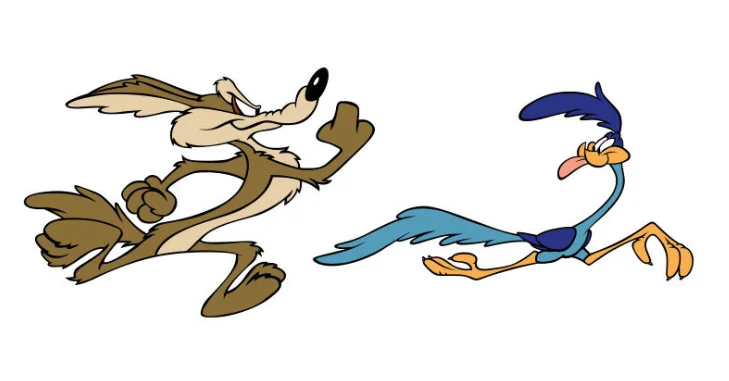
The Road Runner does not need speeches to control a scene. Speed, posture, expressions, and a familiar sound tell viewers what happened. Wile E. often communicates through reactions and signs instead.
The famous “beep-beep” was connected with artist Paul Julian. Jones recalled that Julian made a similar sound while moving through the studio corridors. The sound became inseparable from the character afterward.
The lack of dialogue also gives the shorts an unusual rhythm. Music and sound effects can respond directly to movement. Every launch, fall, collision, or sudden stop becomes part of the comic language.
ACME Products and the Perfect Failed Plan
ACME became one of the series’ best-known recurring ideas. Wile E. orders devices that appear capable of solving his problem. Instead, the equipment usually contributes to another spectacular failure.
The joke works because the coyote trusts complicated technology more than simple instinct. Each new product appears to offer control. The result reminds viewers that his confidence remains much stronger than his luck.
ACME also provides consistency without making every episode identical. Writers can introduce a different machine while preserving the familiar setup. Audiences recognize the pattern but still wait to see how the failure happens.
Artandwriters also covers the production side of entertainment through profiles such as its Cash Warren film production and career profile. That broader context can help readers explore how entertainment careers extend beyond performers.
The Desert Is Part of the Comedy
The desert background is not merely decoration. Long roads allow speed to register clearly, while cliffs create instant danger. Empty spaces make even small movements easy to follow.
Cacti, mesas, rock walls, canyons, and distant horizons also produce a distinctive visual identity. The setting resembles an exaggerated American Southwest. Its simplicity keeps attention on the two characters and the next trap.
Jones treated the environment as part of the comic system. A road can lead toward a painted tunnel or a sudden drop. A cliff can remain harmless until Wile E. notices gravity.
That approach makes backgrounds active storytelling tools. They establish distance, danger, and anticipation without extra dialogue. Few locations could support the chase formula as efficiently.
The Cartoon’s Famous Rules
Fans often associate the series with a set of creative rules attributed to Chuck Jones. They describe ideas such as keeping the action in the desert. They also emphasize self-inflicted failure and limited dialogue.
The rules explain why the series feels consistent even when individual gags change. Wile E. remains responsible for much of his trouble. The Road Runner stays more like an unstoppable natural force than an attacker.
Constraints can also strengthen comedy. Writers must find new outcomes inside an established structure. The audience understands the pattern, so small variations become more noticeable.
Is the Cartoon Road Runner Like a Real Roadrunner?
Only partly. Real roadrunners are ground-oriented birds found in the American Southwest and nearby regions. They can run quickly, but their abilities do not match cartoon physics.
The animated bird also created a lasting misconception about speed. Real coyotes can outrun real roadrunners over short distances. Recent reporting places roadrunners around 15 to 20 mph, while coyotes can run much faster.
That difference does not weaken the joke. The cartoon reverses natural expectations to make the chase work. Its bird must remain unreachable because failure defines Wile E.’s role.
Why the Road Runner Cartoon Still Works
A strong Road Runner cartoon can be understood without knowing decades of Looney Tunes history. One character wants something, another escapes, and the plan fails. That storytelling economy makes the shorts easy to revisit.
The comedy also rewards anticipation. Viewers start predicting the explosion, fall, or mechanical malfunction. The surprise comes from exactly how the expected disaster happens.
Modern audiences can still find official compilations of classic shorts from Warner Bros. These releases continue presenting episodes from the characters’ early decades to new viewers.
The duo has also remained relevant through newer Warner-related projects and renewed attention around Wile E. Coyote. That long cultural life shows how durable the basic chase remains.
For more film-related profiles, Artandwriters’ Spike Lee coverage explores another major figure in American screen culture. Readers can also explore the Gong Li film career profile for a wider international cinema perspective.
What Artists and Writers Can Learn From the Series
The cartoons offer a useful lesson in visual storytelling. A clear goal lets creators spend less time explaining motivation. Every scene can then move directly toward action and consequence.
Repetition also becomes useful when each repetition changes. The coyote always wants roughly the same thing. The machinery, timing, scale, and method of failure keep evolving.
Artists can study silhouette and motion as well. Jones emphasized the importance of drawing speed, dust, and movement around the Road Runner. A strong action pose communicates before details become necessary.
Writers can study escalation. A small problem becomes a larger plan, then a larger failure. That structure remains useful in comedy far beyond animation.
Frequently Asked Questions
Who created the Road Runner cartoon?
Chuck Jones and writer Michael Maltese are closely associated with creating the Road Runner and Wile E. Coyote pairing. Their first short together was Fast and Furious in 1949. Jones directed many of the pair’s best-known classic appearances.
What is the Road Runner’s famous sound?
The character is famous for a “beep-beep” sound. Chuck Jones connected with his original artist, Paul Julian, making a similar noise around the studio. Julian’s vocal effect became a defining part of the character.
Why does Wile E. Coyote use ACME products?
ACME provides the coyote with elaborate tools for his schemes. The products create a repeatable setup for increasingly complicated failures. Their unreliability became one of the series’ most recognizable jokes.
Did Wile E. Coyote ever catch the Road Runner?
The classic formula depends on him failing to secure his goal. Individual productions have occasionally played with that expectation. The continuing joke remains his inability to turn elaborate planning into lasting success.
What was the first Road Runner cartoon?
Fast and Furry-ous was the pair’s debut theatrical short. It was released in 1949 and established their central chase dynamic. Many later episodes refined the formula rather than replacing it.
Why are Road Runner cartoons still popular?
Their stories are simple, visual, and easy to understand. Strong timing gives familiar situations surprising endings. The absence of heavy dialogue also makes the comedy accessible across generations.
A Chase Built to Last
The Road Runner and Wile E. Coyote prove that a simple premise can support decades of comedy. Their best scenes turn anticipation, timing, movement, and failure into a complete visual language. The desert highway becomes a stage where one character escapes, and the other refuses to quit.
That consistency is the real strength of the series. Viewers know the destination but still enjoy the journey toward the next disaster. For more entertainment history and screen-culture features, continue with Artandwriters Entertainment.