
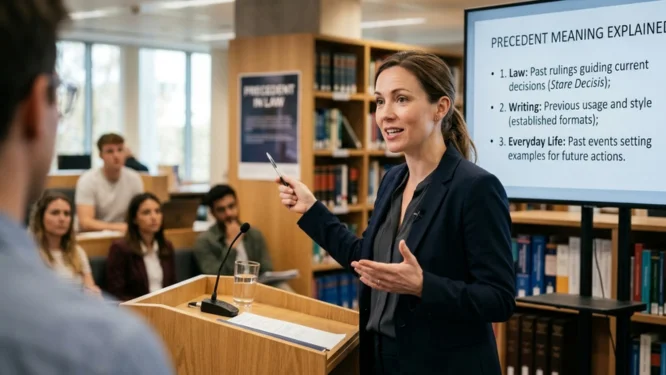
The precedent meaning is easier to understand once you connect it with the idea of something that happened before and now serves as a guide. You may encounter the word in court decisions, news reports, workplace discussions, academic writing, or ordinary conversations. Although it is especially common in law, its basic meaning applies much more broadly.
Quick answer: Precedent means an earlier action, event, or decision that becomes an example or guide for what should happen in a similar situation later. In U.S. law, precedent usually refers to an earlier court decision that judges may follow when deciding a later case involving similar facts or legal issues.
Understanding the word also helps make phrases such as “set a precedent,” “legal precedent,” and “without precedent” much clearer. It is particularly useful to know the difference between precedent and precedence, because the two words sound similar but have different meanings. This guide explains the definition, legal use, pronunciation, synonyms, examples, and common mistakes in plain English.
Key Takeaways
- Precedent is an earlier event, action, or decision that can guide later similar situations.
- In law, a precedent is usually an earlier court decision relevant to a later case with similar facts or legal questions.
- A binding precedent generally must be followed by a lower court within the appropriate judicial hierarchy.
- A persuasive precedent may influence a court but does not necessarily control its decision.
- “Set a precedent” means establishing an example that others may follow in the future.
- Precedence means priority or greater importance, so it should not be confused with precedent.
What Is the Precedent Meaning in Plain English?
In plain English, a precedent is something that happened earlier and can be used as an example when deciding what to do next. The earlier event does not always create a strict rule, but it may influence expectations, decisions, or future behavior. Major dictionaries describe precedent as an earlier occurrence, act, or decision that serves as an example or guide for a later similar situation.
Imagine that a company allows one employee to work remotely for an entire month because of a special situation. Other employees may later point to that decision when asking for the same arrangement, arguing that the company has already allowed it once. The first decision has therefore created a precedent, even though no court or law was involved.
| Context | What precedent means | Simple example |
|---|---|---|
| Everyday life | An earlier action used as an example | A parent allows a later bedtime once |
| Workplace | A previous decision that may influence future decisions | One employee receives a special scheduling exception |
| School | An earlier rule or response that shapes later expectations | A teacher accepts one type of late assignment |
| Business | A past practice used to justify similar treatment | A company refunds a customer under unusual circumstances |
| Law | An earlier judicial decision used in later similar cases | A court applies a rule established by a higher court |
The common idea in all of these examples is what happened before influencing what happens afterward. Sometimes that influence is informal, as with a family rule or business policy. In law, however, precedent can carry much greater authority.
What Does Precedent Mean in Law?
In U.S. law, precedent generally refers to an earlier court decision involving similar facts or legal issues that may guide the resolution of a later case. The U.S. Courts glossary explains that judges generally follow principles established in earlier similar cases when deciding new disputes. Cornell Law School’s Legal Information Institute likewise describes precedent as a prior judicial decision treated as authority in later cases involving similar facts or legal questions.
This does not mean that every old court ruling automatically determines every new case. Courts consider whether the earlier case addressed the relevant legal issue, whether its facts are sufficiently similar, and whether the earlier court had authority over the court deciding the new dispute. Differences in facts, jurisdiction, procedural posture, or controlling law can affect how much weight a previous decision receives.
The legal meaning is closely connected with case law, which develops through judicial decisions rather than only through statutes enacted by legislatures. The U.S. Courts glossary describes case law as law established through previous court decisions and identifies legal precedent as a closely related concept. For readers comparing court-created rules with legislation, Art and Writers’ guide to statutory meaning explains how statutory rules differ from rules developed through judicial decisions.
Binding Precedent vs. Persuasive Precedent
A binding precedent is an earlier legal ruling that a court is required to follow when the relevant hierarchy, jurisdiction, legal issue, and factual circumstances make that precedent controlling. Decisions from higher appellate courts generally bind lower courts within the same judicial system on the legal questions those decisions resolve. Cornell explains that a binding precedent is a legal rule articulated by an appellate court that lower courts within its jurisdiction must follow in appropriate similar cases.
A persuasive precedent, by comparison, may help a judge decide a case without legally requiring a particular result. A decision from another jurisdiction, for example, may offer useful reasoning even when it does not control the court considering the new dispute. Judges may consider such decisions because their reasoning is relevant or convincing, but persuasive authority and binding authority are not the same thing.
How Stare Decisis Relates to Precedent
The legal doctrine associated with following precedent is called stare decisis. That Latin expression is commonly translated as “to stand by things decided.” It supports the idea that courts should generally apply previously established legal principles when sufficiently similar issues arise again. Cornell notes that the doctrine helps courts adhere to precedent while distinguishing between decisions that are binding and those that are merely persuasive.
The purpose is partly to encourage consistency and predictability in the legal system. People, lawyers, businesses, and government institutions can make decisions more confidently when similar legal questions are generally treated in similar ways. Precedent can change or be overruled in appropriate circumstances, however, so stare decisis does not mean that every previous decision remains permanent forever.
7 Clear Examples of Precedent in Everyday English
Examples are often the fastest way to understand the precedent meaning because they show how the same idea operates in several settings. The word can describe something formal, such as a judicial ruling, or something as ordinary as a household decision. In every case, an earlier action becomes relevant to a later choice.
| Example | Why it is a precedent |
|---|---|
| A judge follows an earlier appellate ruling involving the same legal issue. | The earlier case guides the later court decision. |
| A company gives one employee an unusual benefit and later receives similar requests. | The original exception becomes an example others can cite. |
| A school allows students to redo one particular type of assignment. | Students may expect the same opportunity in future cases. |
| Parents let one child stay out late for a special event. | Another child may later use that decision as an example. |
| A landlord makes an exception to a building rule for one tenant. | Other tenants may expect comparable treatment. |
| A sports organization changes a rule after handling an unusual event. | The response may guide future situations involving the same issue. |
| A business refunds a purchase outside its normal policy. | Customers or employees may refer to that decision in later cases. |
These examples show why people sometimes hesitate before making an exception. A decision made for one unusual situation can create expectations about how similar situations will be handled in the future. Saying “I don’t want to set a precedent” usually means the speaker does not want one decision to become a model for later decisions.
What Does “Set a Precedent” Mean?
To set a precedent means to do something that establishes an example, pattern, or standard that may influence what happens later. The expression is especially common when a decision is new or unusual and people expect others to refer back to it. Merriam-Webster notes that precedent frequently appears in the phrase “set a precedent,” meaning to establish an example or rule that may be followed in the future.
| Phrase | Meaning |
|---|---|
| Set a precedent | Establish an example that may guide future actions |
| Follow precedent | Act consistently with an earlier example or ruling |
| Legal precedent | An earlier judicial decision relevant to later cases |
| Break with precedent | Depart from an established practice or earlier approach |
| Without precedent | Having no known earlier comparable example |
| Dangerous precedent | An earlier action that may encourage undesirable future actions |
The phrase does not necessarily mean that the new example becomes a legally enforceable rule. Outside the courtroom, people often use it simply to describe expectations created by earlier behavior. In a legal discussion, you must look more carefully at the court, jurisdiction, issue, and authority involved.
Precedent vs. Precedence: What Is the Difference?
While “precedent” and “precedence” look and sound almost identical—especially when comparing the plural “precedents” to “precedence”—they carry distinct legal and everyday meanings. The former refers to an earlier decision or event that serves as a guide for future situations, whereas the latter signifies priority, rank, or the right to take precedence over something else. Merriam-Webster specifically distinguishes “set a precedent” from expressions such as “take precedence.”
For example, “Safety takes precedence over speed” means safety has the higher priority. By contrast, “The company’s decision set a precedent for future requests” means that an earlier decision may serve as an example later. A useful memory trick is to connect precedent with previous example and precedence with priority.
| Correct expression | Meaning |
|---|---|
| Set a precedent | Create an example |
| Follow a precedent | Follow an earlier example or ruling |
| Take precedence | Have greater priority |
| Give something precedence | Treat something as more important |
How Do You Pronounce Precedent?

As a noun, precedent is commonly pronounced approximately PRES-ih-duhnt in American English. The stress falls on the first syllable, which is the pronunciation most people will hear when the word refers to an earlier example or legal decision. Major dictionaries provide this noun pronunciation while also recognizing less common grammatical uses of the word.
The adjective “precedent,” meaning preceding or coming before, is much less common in everyday modern English and may be pronounced differently. Most U.S. readers searching for the word are looking for the noun, particularly in expressions such as “legal precedent” or “set a precedent.” For ordinary writing and conversation, remembering PRES-ih-duhnt will cover the most common use.
Synonyms for Precedent
The best synonym depends on the sentence because precedent can refer to a general example, an established pattern, or a legal authority. Common alternatives include example, model, pattern, standard, instance, and, in some legal contexts, authority. Dictionary sources similarly associate the word with ideas such as example, standard, model, and pattern.
| Synonym | Best use |
|---|---|
| Example | General everyday situations |
| Model | Something intended to be copied |
| Pattern | Repeated behavior or practice |
| Standard | A benchmark or established expectation |
| Instance | A previous occurrence |
| Authority | Certain legal contexts |
These words are related rather than perfectly interchangeable. A precedent normally emphasizes that something earlier has relevance to a later similar situation, while an example does not always carry that time-based relationship. In legal writing, replacing “precedent” with a casual synonym can also remove an important technical distinction.
How to Use Precedent in a Sentence
When using the word yourself, ask whether you are referring to something earlier that may influence a later similar decision. If the answer is yes, precedent is probably the right word. If you mean that one issue has a higher priority than another, you probably need precedence instead.
| Sentence | What it means |
|---|---|
| “The ruling established an important precedent.” | The ruling may guide later similar cases. |
| “We do not want to set a precedent for future exceptions.” | The speaker does not want one exception to become an example. |
| “The attorney cited precedent from an earlier appellate case.” | The attorney relied on an earlier judicial decision. |
| “There was no precedent for handling the situation.” | Nothing sufficiently similar had happened before. |
| “The company followed its previous precedent.” | The company acted consistently with an earlier practice. |
Context remains important when a word can have both ordinary and legal meanings. Art and Writers uses the same context-first approach in its plain-English explanation of soliciting meaning, where everyday and legal uses also differ. Readers researching additional legal vocabulary can also explore the site’s Law section.
Common Mistakes When Using Precedent
Most mistakes involve confusing precedent with precedence or assuming that every previous legal decision is automatically binding. Another common error is treating any event that happened earlier as a meaningful precedent, even when it has little connection with the later situation. A useful precedent normally has enough similarity or relevance to make the earlier example worth considering.
| Mistake | Better approach |
|---|---|
| Writing “set a precedence” | Write “set a precedent” |
| Writing “precedent takes precedent” | Write “precedent takes precedence” when discussing priority |
| Assuming every court decision is binding | Check the court, jurisdiction, hierarchy, and legal issue |
| Treating different facts as identical | Compare the relevant facts and legal questions |
| Assuming precedent can never change | Remember that courts can distinguish or overrule earlier decisions |
Legal readers should also remember that precedent is more technical than a simple dictionary definition may suggest. The authority of a particular decision depends on the court system and the relationship between the earlier and later cases. When an actual legal dispute is involved, the relevant opinions and applicable jurisdiction should be checked rather than relying on a general vocabulary article.
Precedent, Case Law, and Statutory Law
Precedent is closely connected to case law, because case law develops from judicial opinions and prior court decisions. Statutory law, by contrast, comes from legislation enacted by a legislative body. Courts often interpret statutes, and those interpretations can themselves become important precedents for later disputes involving the same statutory language.
That interaction is one reason legal documents can seem confusing to beginners. A statute may provide the written rule, while earlier court decisions explain how particular language should be interpreted or applied. Understanding both the statutory source and relevant precedent can therefore be important when determining what a legal rule actually requires.
The federal judiciary’s U.S. Courts Glossary of Legal Terms defines precedent as a court decision in an earlier case whose facts and legal issues resemble those of a dispute currently before a court. Cornell Law School’s Legal Information Institute explanation of precedent states that courts treat such a prior decision as authority when deciding later cases raising similar questions. These sources are more appropriate for legal questions than assuming that the everyday meaning alone explains how a particular court must rule.
The Bottom Line
The precedent meaning comes down to a simple idea: an earlier example can influence what happens in a similar situation later. In everyday English, that may mean a previous decision creates an expectation, while in U.S. law it often refers to an earlier judicial ruling that may guide or control later cases. Remember the distinction from precedence, check context whenever the word appears, and look at the relevant court and jurisdiction before assuming that a legal precedent is binding.
Frequently Asked Questions
What is the simplest meaning of precedent?
A precedent is an earlier action, event, or decision that serves as an example for a later similar situation. The key idea is that something from the past helps influence what should happen next. It can apply to ordinary decisions, business practices, school rules, workplace policies, and court cases.
What does precedent mean in court?
In court, precedent generally means an earlier judicial decision involving a similar legal issue or factual situation that may guide a later decision. Some precedents are binding because of the relationship between the courts, while others are only persuasive. The authority of a particular decision therefore depends on the jurisdiction, court hierarchy, and issues involved.
What does it mean to set a precedent?
To set a precedent means to make a decision or take an action that can become an example for similar situations in the future. Someone may deliberately establish a precedent, or an ordinary exception may unintentionally create one. The phrase is common in law, business, politics, workplaces, schools, and family discussions.
Is precedent the same as law?
Not exactly, although binding judicial precedent can be an important source of law in the U.S. legal system. Statutes are enacted by legislatures, while case law develops through judicial decisions and precedent. The relationship between the two varies depending on the legal question and the authority governing the dispute.
Is precedent the same as precedence?
No, the words have different meanings despite their similar spelling and sound. Precedent is an earlier example or decision, while precedence means priority or greater importance. You therefore “set a precedent,” but one responsibility may “take precedence” over another.
Can a legal precedent be overturned?
Yes, some precedents can later be overruled, limited, or distinguished depending on the court and circumstances. Courts may also determine that an earlier case does not control because the relevant facts or legal issues are materially different. That is why saying that a precedent exists does not, by itself, completely answer how a new case will be decided.