

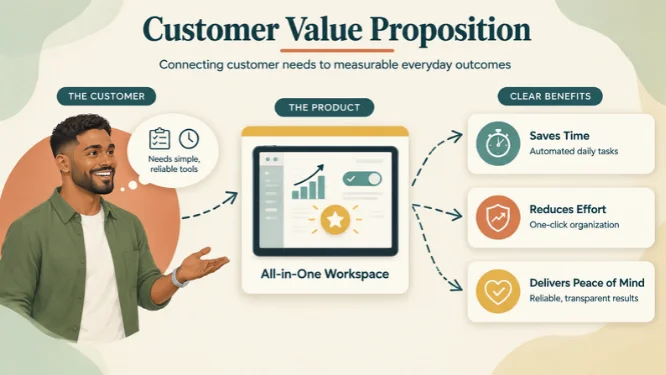
A customer value proposition explains why a specific buyer should choose your offer instead of another option. It connects a real customer problem with a useful outcome your business can deliver. Strong messaging focuses on customer priorities rather than listing every product feature.
Cambridge defines the concept around the reason someone buys based on the value an offer provides. That makes customer understanding the starting point, not clever copywriting. Your statement should tell buyers what improves for them after choosing you.
Quick answer: A strong CVP identifies a specific customer, an important problem, and the outcome your offer creates. It also explains why your approach deserves attention over alternatives. The clearest statements use customer language, focus on meaningful benefits, and support important promises with evidence.
Customer Value Proposition at a Glance
| Element | What it should answer | Example |
|---|---|---|
| Target customer | Who is this specifically for? | Independent U.S. retailers |
| Customer problem | What difficulty needs solving? | Slow inventory decisions |
| Desired outcome | What improvement matters? | Less unsold stock |
| Differentiator | Why choose this option? | Demand data updated daily |
| Evidence | Why should buyers believe it? | Customer results or measured data |
| Final message | What is the concise promise? | Make faster inventory decisions using current demand signals |
Key takeaways
- Start with one defined customer segment.
- Identify important jobs, pains, and desired gains.
- Translate features into meaningful customer outcomes.
- Prioritize benefits rather than listing everything you offer.
- Explain a believable difference from competing alternatives.
- Support strong claims with customer evidence.
- Test the wording before treating it as final.
What Makes a Strong CVP Different From a Slogan?

A Customer Value Proposition slogan is usually designed to be memorable, while a CVP has a more demanding job. It must explain why an offer deserves the buyer’s attention. A memorable phrase without useful customer meaning rarely answers that question.
A unique selling proposition emphasizes competitive difference. A CVP goes further by connecting that difference with an outcome the buyer values. Business Queensland similarly advises businesses to connect meaningful differences with benefits their target customers care about.
That distinction matters for small businesses competing against larger brands. You don’t always need more features, lower prices, or a louder message. You need a clearer reason for the right customer to choose you.
Customer Value Proposition, Not Your Product
Teams often begin by describing what they sell. Buyers usually evaluate an offer from the opposite direction. They first consider their problem, desired result, risk, cost, and available alternatives.
Strategyzer’s Value Proposition Canvas separates the customer profile into jobs, pains, and gains. The value side then identifies products, pain relievers, and gain creators. The purpose is to find meaningful matches between customer priorities and what the business provides.
This framework also prevents a common messaging mistake. Businesses frequently promote features that customers consider secondary. Researching customer priorities helps you choose benefits that deserve space in your final statement.
How to Create a Customer Value Proposition in 6 Steps
1. Define one target customer
Choose a customer segment specific enough to have recognizable priorities. “Small businesses” may still cover thousands of different buying situations. “Independent U.S. dental practices with fewer than ten employees” gives you clearer problems to investigate.
Your segment can reflect industry, business size, customer type, buying situation, or another meaningful factor. Avoid adding demographic details that don’t affect the purchase decision. The goal is useful focus rather than unnecessary profiling.
For more business-focused reading, explore Artandwriters’ Business section. Its broader business coverage can support related internal content paths. That connection also helps readers move from messaging topics into other business subjects.
2. Identify the customer’s important job
Ask what the customer is trying to accomplish rather than what product they want. A restaurant owner may need predictable reservations instead of “marketing software.” A freelancer may need qualified client inquiries instead of “more website traffic.”
Customer jobs can involve practical, emotional, or social outcomes. Strategyzer recommends examining tasks, problems, and needs instead of viewing buyers only through product features.
Talk with customers whenever possible before finalizing your assumptions. Sales calls, support conversations, interviews, and reviews can reveal useful language. Search behavior can also show how people describe problems before they know your solution.
3. Find the pains worth solving
Not every customer frustration deserves equal attention. Focus on problems connected with money, time, effort, uncertainty, risk, or an important desired result. Stronger problems usually create stronger reasons to act.
Suppose a scheduling platform offers automatic appointment reminders. The feature itself is not the main customer benefit. Reduced missed appointments and less administrative work are closer to the value a buyer evaluates.
Rank pains by frequency and severity before writing your statement. Then compare that ranking with what your offer can credibly improve. This keeps your message centered on problems where your solution has meaningful relevance.
4. Translate features into outcomes
Create two columns and place your main features in the first. In the second, write what each feature changes for the customer. Keep asking, “What does this allow the customer to do better?”
Consider cloud backup as an example. “Automatic encrypted backup” describes a capability. “Recover important files after a device failure without depending on manual backups” describes a customer outcome.
This exercise makes marketing copy more concrete. It also helps you remove features that don’t strengthen the buying case. Your final message becomes about improvement rather than specifications.
5. Explain your meaningful difference
A useful difference must matter to the customer. Being different for its own sake adds little value. Buyers care whether that difference produces a better result, lower risk, less effort, or another relevant advantage.
Harvard Business Review has warned against broad benefit claims that lack supporting evidence. Business buyers may dismiss unsupported promises as marketing language. Important advantages become more persuasive when companies can demonstrate them.
Compare your offer with direct competitors, current workarounds, and doing nothing. Sometimes your strongest advantage is not a product feature. Faster implementation, specialized expertise, simpler pricing, or better support may matter more.
6. Write, test, and refine the message
Build the first draft from the information you collected. A practical formula is: We help [specific customer] achieve [important outcome] by [credible differentiator]. Treat that sentence as a starting structure rather than mandatory final wording.
Salesforce recommends identifying the audience, pain points, solution, benefits, competitive distinction, and supporting proof. That sequence keeps the message connected with actual buyer concerns. It also encourages evidence instead of unsupported claims.
Show several versions to real customers or qualified prospects. Ask what they think the offer does and why it matters. Revise unclear language when readers interpret the promise differently than intended.
A Practical U.S. Small-Business Example
Imagine a bookkeeping company serving independent U.S. contractors. Its original homepage message says, “Full-service bookkeeping with powerful financial reporting.” That description names the service but provides little reason to choose it.
Customer interviews reveal two stronger concerns. Contractors lose evenings organizing receipts and worry about finding records during tax season. They value saved time and organized financial information more than the phrase “powerful reporting.”
A stronger statement could say: “Keep your books organized and tax-ready without spending your evenings sorting receipts.” The message describes an outcome the customer understands. Supporting copy can then explain monthly reconciliation, document organization, reporting, and other service details.
Businesses developing similar acquisition messaging can also review Artandwriters’ Digital Marketing section. Customer positioning and digital promotion work best when they support the same promise. Consistent messaging reduces confusion as buyers move between channels.
What a Value Proposition Should Not Do
Avoid trying to communicate every advantage in one statement. Long lists weaken priority and make the reader decide which benefit matters. Choose the outcome that gives your target customer the strongest reason to continue reading.
Avoid vague words such as “quality,” “innovative,” or “industry-leading” unless you explain what they mean. Specific language gives buyers something they can evaluate. Evidence makes important claims easier to trust.
Don’t assume the first version is finished. A statement written only from internal opinions remains an assumption. Customer conversations, sales results, and message testing can reveal whether the promise matches genuine demand.
How to Test Whether Your Message Works
The first test is comprehension. Show the message without additional explanation and ask readers what they think the company provides. Their answers should closely match your intended meaning.
The second test is relevance. Ask whether the promised outcome solves an important problem for that customer segment. A perfectly clear message still fails when customers don’t care about its central benefit.
The third test is credibility. Customers should understand why your company can deliver the promised result. Testimonials, case studies, measurable outcomes, demonstrations, guarantees, or transparent processes can provide supporting evidence.
Strategyzer also treats fit as something customers must confirm rather than something teams can declare internally. The canvas helps form the hypothesis, while testing provides evidence.
Common Mistakes That Weaken the Message
Several recurring mistakes can turn promising positioning into generic marketing copy:
- Targeting everybody instead of one meaningful segment.
- Leading with product features instead of customer outcomes.
- Making broad promises without supporting evidence.
- Copying competitor wording instead of studying customer priorities.
- Trying to mention every pain, gain, and feature.
- Using internal terminology customers rarely use themselves.
- Treating the first draft as permanent.
- Confusing differentiation with being unusual.
Customer research can also include how prospects currently seek vendors or information. Artandwriters’ guide to what soliciting means provides useful context about how businesses actively seek customers. That broader acquisition perspective can help connect positioning with sales outreach.
Where the CVP Belongs in Your Marketing
Your central customer promise should influence more than the homepage headline. It can shape landing pages, sales presentations, advertisements, email campaigns, product descriptions, and onboarding messages. Each channel can expand the promise without changing its basic meaning.
Sales teams can use the same positioning when qualifying prospects. Product teams can compare requested features with the customer outcomes the company wants to own. Leadership can also use the message to clarify which customers and benefits deserve investment.
Consistency does not require identical sentences everywhere. Different channels need different levels of detail. The customer, problem, desired outcome, and meaningful difference should still remain recognizable.
Turn Customer Insight Into a Clear Reason to Choose You
Strong positioning starts before the final sentence gets written. First understand the customer, their important problem, and the result they value. Then connect that knowledge with a difference your business can genuinely deliver.
Keep the finished statement clear enough for someone outside your company to understand. Support the strongest promises with evidence and test them with real buyers. The goal is not clever wording but a reason to choose your offer that customers recognize.
Use your draft across a landing page, sales conversation, or campaign and monitor the response. Compare message versions when you have enough traffic or customer feedback. Keep the version that improves understanding and attracts better-fit prospects.
Frequently Asked Questions
What is a customer value proposition?
It is a clear explanation of why a particular buyer should choose one offer over available alternatives. It connects the customer’s needs with a relevant benefit the business can credibly provide. Strong versions are specific enough to guide both marketing and buying decisions.
What are the main elements of a good CVP?
Start with a defined customer, an important problem, and a desired outcome. Add the meaningful difference that helps your offer produce that outcome. Support significant promises with evidence whenever buyers need reassurance.
How long should the statement be?
There is no universal word limit that works for every company. The central statement should usually be short enough to understand quickly. Supporting copy can explain proof, features, limitations, and additional benefits.
Is a CVP the same as a USP?
They overlap, but their emphasis differs. A USP usually highlights what distinguishes an offer from competitors. A CVP connects meaningful differences with the value a specific customer expects to receive.
How often should a business update its message?
Review it when customer priorities, products, competition, or buying conditions change. You should also revisit it when sales conversations repeatedly reveal confusion. Customer evidence should determine whether a change is necessary.