
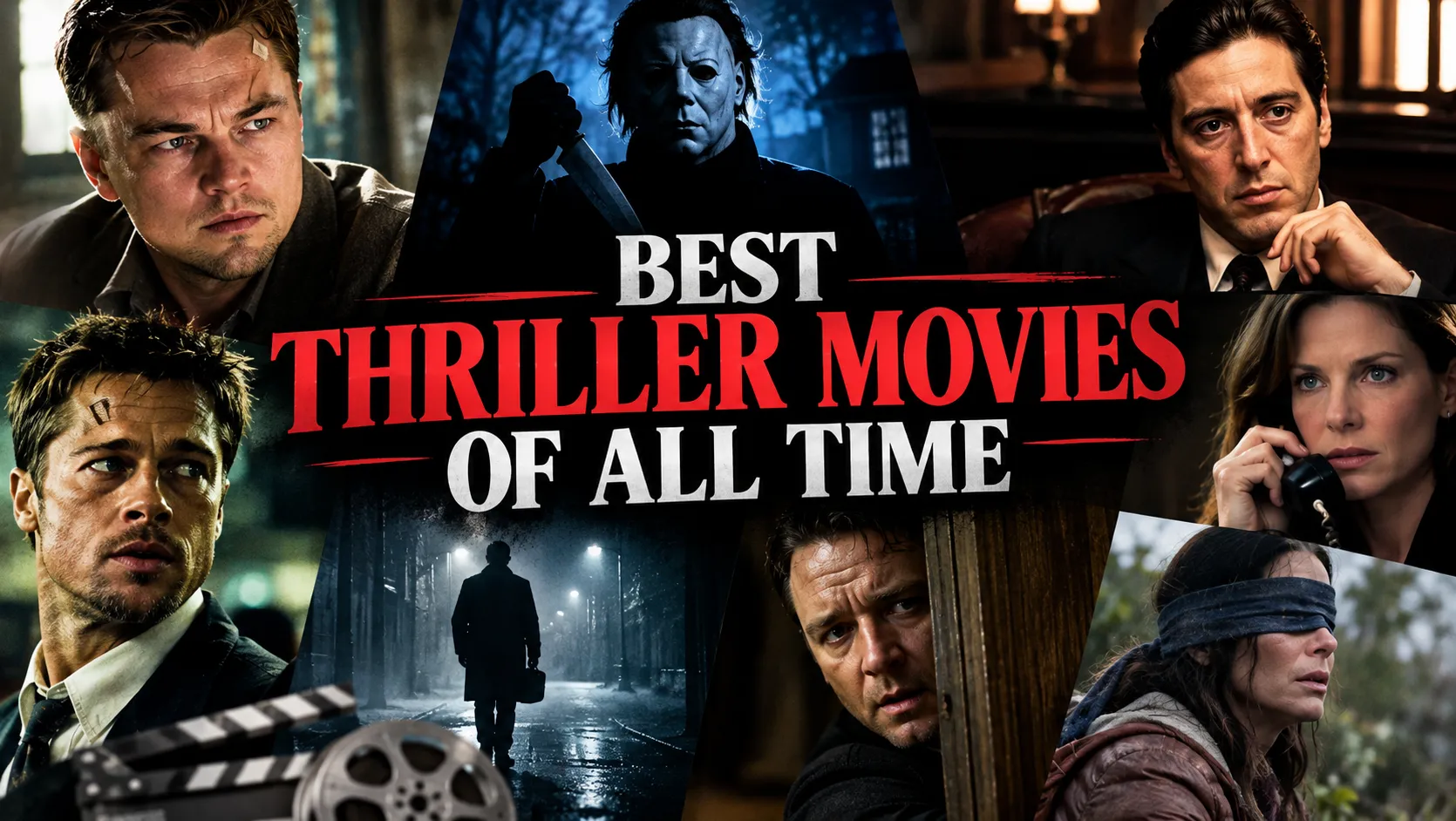
Some films create tension with a ticking clock, while others make a quiet room feel dangerous. The best thriller movies of all time do both without wasting their biggest surprises. These 15 films span psychological suspense, crime, mystery, horror, and international cinema.
Quick answer: The essential thriller canon includes Psycho, Rear Window, The Silence of the Lambs, Se7en, Zodiac, and Parasite. Each creates suspense differently, from Hitchcock’s careful visual control to Fincher’s procedural dread. The list below ranks 15 films for tension, influence, filmmaking, performances, and lasting rewatch value.
Thriller Movies at a Glance
| Rank | Movie | Year | Director | Best For |
|---|---|---|---|---|
| 1 | The Silence of the Lambs | 1991 | Jonathan Demme | Psychological suspense |
| 2 | Psycho | 1960 | Alfred Hitchcock | Classic suspense |
| 3 | Seven | 1995 | David Fincher | Dark crime |
| 4 | Parasite | 2019 | Bong Joon Ho | Social suspense |
| 5 | Rear Window | 1954 | Alfred Hitchcock | Mystery |
| 6 | Zodiac | 2007 | David Fincher | True-crime procedural |
| 7 | No Country for Old Men | 2007 | Joel and Ethan Coen | Cat-and-mouse tension |
| 8 | The Departed | 2006 | Martin Scorsese | Crime |
| 9 | Gone Girl | 2014 | David Fincher | Twisted relationships |
| 10 | Memento | 2000 | Christopher Nolan | Puzzle mystery |
| 11 | Prisoners | 2013 | Denis Villeneuve | Missing-person mystery |
| 12 | Vertigo | 1958 | Alfred Hitchcock | Psychological mystery |
| 13 | The Fugitive | 1993 | Andrew Davis | Chase thriller |
| 14 | Memories of Murder | 2003 | Bong Joon Ho | Police procedural |
| 15 | Uncut Gems | 2019 | Josh and Benny Safdie | Maximum anxiety |
How We Chose These Films
A great thriller needs more than a surprising ending. Suspense should shape the entire experience, including pacing, framing, sound, character choices, and withheld information. A film also earns extra weight here when its techniques remain effective after its secrets are known.
This ranking balances critical reputation, audience response, influence, and sustained tension. Current major genre lists also show how broad the category has become. Crime stories, psychological dramas, horror hybrids, and international films can all qualify when suspense drives the experience.
The 15 Best Thriller Movies of All Time, Ranked
15. Uncut Gems (2019)
Howard Ratner seems capable of escaping every disaster except the next one he creates. Adam Sandler gives the character enough charm to make his reckless decisions painfully watchable. The Safdie brothers turn overlapping conversations, crowded rooms, and bad bets into sustained cinematic pressure.
Pros: Relentless pacing, a fearless central performance, and exceptional sound design.
Cons: Its noise and anxiety can exhaust viewers who prefer slower suspense.
14. Memories of Murder (2003)
Bong Joon Ho follows detectives investigating killings in provincial South Korea during the 1980s. The investigation shifts between dark comedy, institutional frustration, and genuine dread. Those changes make the disturbing moments harder to predict.
The film also resists the neat certainty common to police stories. Investigators make mistakes, evidence fails, and confidence repeatedly proves unreliable. That ambiguity gives the final moments unusual staying power. Viewers who enjoy international cinema can also explore the work of Chinese film star Gong Li.
13. The Fugitive (1993)
Harrison Ford plays Dr. Richard Kimble, who escapes custody after being wrongly convicted of murdering his wife. Tommy Lee Jones pursues him as Deputy U.S. Marshal Samuel Gerard. Their parallel pursuit gives the movie both mystery and constant forward motion.
The action remains unusually clear because each set piece advances the investigation. Kimble isn’t simply running from danger; he’s trying to uncover the truth. That combination makes The Fugitive an accessible choice for viewers who want suspense without extreme darkness.
12. Vertigo (1958)
James Stewart plays a former detective hired to follow a mysterious woman through San Francisco. What initially resembles an investigation gradually becomes a disturbing study of obsession. Alfred Hitchcock uses color, perspective, and repetition to make desire itself feel threatening.
The film moves more slowly than modern studio suspense. That deliberate pace gives its psychological details room to accumulate. Viewers seeking atmosphere and ambiguity may find more to unpack with each rewatch.
11. Prisoners (2013)
Two young girls disappear, and a desperate father becomes convinced he knows who is responsible. Hugh Jackman and Jake Gyllenhaal approach the case from opposite directions. Denis Villeneuve steadily pushes both men toward uncomfortable moral territory.
Roger Deakins’ cold photography turns ordinary Pennsylvania locations into spaces filled with menace. To see how a cinematographer shapes a film’s look, read about Daniel Moder’s career behind the camera. The mystery matters, but the characters’ choices create the deeper tension. Few modern crime films make desperation feel this physically oppressive.
10. Memento (2000)
Christopher Nolan structures this revenge mystery around Leonard Shelby, a man unable to form new long-term memories. Major scenes move backward, forcing viewers to reconstruct events beside him. The unusual structure isn’t decoration because it controls what the audience can trust.
Guy Pearce keeps Leonard sympathetic even as new information changes our understanding of him. Every apparent answer creates another uncertainty. The result remains one of the strongest puzzle films of the early 2000s.
9. Gone Girl (2014)
A woman’s disappearance transforms her husband into a national suspect under intense media scrutiny. David Fincher turns Gillian Flynn’s story into a cold examination of marriage, performance, and public perception. Rosamund Pike and Ben Affleck make the central relationship increasingly difficult to read.
The film works because its major revelations don’t end the suspense. They change the nature of the conflict instead. That structural confidence gives Gone Girl more replay value than a mystery dependent on one twist.
8. The Departed (2006)
Martin Scorsese builds this Boston crime story around two men living dangerous double lives. Leonardo DiCaprio infiltrates organized crime, while Matt Damon’s character works inside law enforcement. Each man must identify the other before his own identity is exposed.
The setup creates tension during conversations that might otherwise seem routine. A phone call or misplaced envelope can become as dangerous as a gun. The large supporting cast also keeps the story energetic across its lengthy runtime.
7. No Country for Old Men (2007)
A hunter finds money after a failed drug deal and decides to keep it. That choice puts him in the path of Anton Chigurh, played with frightening calm by Javier Bardem. The Coen brothers build suspense from geography, silence, and small practical decisions.
Several sequences unfold with little dialogue or conventional music. Viewers must watch doors, shadows, footsteps, and improvised traps instead. That restraint makes the violence feel sudden rather than routine.
6. Zodiac (2007)
Zodiac follows journalists and investigators trying to identify the killer who terrorized Northern California. David Fincher focuses less on conventional pursuit than on the consuming need for an answer. Jake Gyllenhaal, Mark Ruffalo, and Robert Downey Jr. anchor different sides of that obsession.
The movie’s power comes partly from uncertainty. Evidence accumulates without providing the clean resolution expected from a fictional mystery. That makes Zodiac an excellent choice for viewers who prefer detailed investigations over rapid action.
5. Rear Window (1954)
A photographer confined to his apartment begins watching neighbors through his rear window. He gradually suspects that one of them has murdered his wife. Hitchcock turns a courtyard and several apartment windows into an entire suspense machine.
James Stewart’s restricted viewpoint also restricts the audience. We see clues, but we can’t immediately investigate them. Grace Kelly’s increasingly active role raises the stakes once observation turns into direct danger.
4. Parasite (2019)
Bong Joon Ho begins with a struggling family gradually entering the household of a wealthy family. The early scenes mix comedy, deception, and class observation. Then the story changes direction without abandoning anything established before that turn.
The suspense works because the physical design of the house matters to the plot. Stairs, windows, rooms, and hidden spaces reveal relationships between characters. The result combines social commentary with precise genre filmmaking.
3. Se7en (1995)
Two detectives hunt a murderer who organizes his crimes around the seven deadly sins. Morgan Freeman brings weary patience, while Brad Pitt supplies restless energy. Their contrasting approaches give David Fincher’s bleak investigation a strong human center.
The unnamed city feels permanently wet, crowded, and decaying. Production design creates dread before the killer’s plan becomes clear. Its final stretch remains famous because earlier details prepare the audience without making the destination obvious.
2. Psycho (1960)
Psycho changed what audiences could expect from a mainstream suspense film. Hitchcock disrupts narrative expectations, shifts attention between characters, and uses editing to make viewers imagine more violence than they see. Bernard Herrmann’s string-heavy score intensifies that uncertainty.
Its influence reaches far beyond the thriller genre. Later horror, slasher, mystery, and psychological films borrowed from its structure and visual language. More importantly, the movie still generates tension even when viewers know its famous secrets.
1. The Silence of the Lambs (1991)
Jonathan Demme’s film combines an investigation with a psychological contest between FBI trainee Clarice Starling and imprisoned killer Hannibal Lecter. Jodie Foster makes Clarice observant, determined, and vulnerable without reducing her to a victim. Anthony Hopkins creates menace through controlled speech and unnerving stillness.
The film’s close-ups make conversations feel confrontational. Characters frequently appear to look directly toward the viewer, tightening the psychological pressure. Its suspense also survives beyond Lecter’s famous scenes because Clarice’s investigation has its own escalating danger.
Verdict: Start here if you want one film representing the genre’s range. It combines crime, mystery, psychological tension, memorable performances, and disciplined filmmaking. Its balance of character and suspense earns the top position on this list.
Which Thriller Should You Watch First?
Your ideal starting point depends on the kind of tension you enjoy. Choose Rear Window for a classic mystery, Zodiac for procedural detail, or Uncut Gems for relentless pressure. Parasite is an excellent option when you want social themes alongside unpredictable genre shifts.
For darker crime, Se7en and The Silence of the Lambs remain dependable choices. Viewers who dislike graphic material may prefer The Fugitive or Rear Window. Fans of puzzles should begin with Memento before moving toward more ambiguous mysteries.
What Makes a Great Thriller Movie?
Thrillers create tension by controlling information. The audience usually knows enough to anticipate danger but not enough to feel safe. Strong examples make that uncertainty meaningful instead of relying on random twists.
Pacing also matters, although fast pacing isn’t required. Zodiac creates pressure through patient investigation, while Uncut Gems rarely gives viewers time to settle. Both work because their rhythms match their characters and conflicts.
The strongest films also remain compelling after their surprises are known. Once a twist loses its novelty, direction, performance, atmosphere, and character must carry the movie. That durability separates an entertaining mystery from an enduring thriller.
Best Thriller Movies of All Time by Mood
| If You Want… | Watch |
|---|---|
| A psychological battle | The Silence of the Lambs |
| Classic suspense | Psycho |
| A serial-killer investigation | Se7en |
| A smart social thriller | Parasite |
| A mystery with minimal locations | Rear Window |
| A detailed procedural | Zodiac |
| A tense chase | The Fugitive |
| A puzzle narrative | Memento |
| Relationship manipulation | Gone Girl |
| Two hours of escalating anxiety | Uncut Gems |
These categories can make choosing easier than following the ranking alone. A slower procedural creates a different experience from a chase film. Start with the mood you want, then explore neighboring styles.
Frequently Asked Questions
What are the best thriller movies of all time?
The Silence of the Lambs, Psycho, Se7en, Parasite, and Rear Window form a strong starting five. They cover psychological, crime, social, and classic suspense. Each also rewards repeat viewing beyond its central mystery.
What is a good thriller for someone new to the genre?
The Fugitive is an accessible starting point because its story is clear and fast-moving. It mixes investigation, action, and character without becoming excessively grim. Rear Window is another strong choice for viewers interested in classic Hollywood.
What is the difference between horror and thriller films?
Horror usually aims to create fear, while thrillers primarily build suspense and anticipation. The categories frequently overlap, especially in films such as Psycho and The Silence of the Lambs. Genre labels describe tendencies rather than rigid boundaries.
Which psychological thrillers should I watch?
Start with The Silence of the Lambs, Vertigo, Gone Girl, and Memento. Each uses psychology differently, ranging from manipulation to obsession and unreliable memory. They also demonstrate how suspense can emerge from character rather than action.
What thriller should I watch if I love plot twists?
Memento, Gone Girl, and Parasite all reshape the viewer’s understanding as their stories progress. Their surprises work because earlier scenes support later revelations. Avoid reading detailed plot summaries before watching them.
Final Picks for Your Watchlist
A useful thriller watchlist should cover more than one style or decade. Start with The Silence of the Lambs, then try Psycho, Parasite, Zodiac, and Rear Window. Those five show how suspense techniques changed while the genre’s central appeal remained remarkably consistent.
After that, choose according to your preferred mood rather than chasing another ranking. Try Uncut Gems for anxiety, Memento for puzzles, or The Fugitive for a polished chase. Save this list and cross off the films as you watch them.